
Most people assume small investments simply produce smaller returns. The...
Read More

Want Better Returns? Start by Understanding the Structure Behind Them
If you’ve ever shared a dessert platter, you know structure matters.
Without one, someone’s fork “accidentally” claims the best piece—and suddenly you’re left negotiating for crumbs.
In real estate investing, the structure that governs how profits are divided is your fork policy.
It decides who eats first, who gets the biggest bite, and who’s left licking the plate.
The three main models you’ll see are:
Straight Split, Pari Passu, and Waterfall.
Let’s compare how each one treats your money, motivation, and risk.
The Core Question
When an investment makes money, there’s a sequence that determines who gets paid and when.
That sequence can either align everyone’s interests or create tension between investors and operators.
The structure you choose dictates which it will be.
So, How Does It Stack Up Against Other Models?
Let’s look at the common alternatives investors encounter:
1. Straight Split (a.k.a. Flat Split)
This one’s simple: profits are split 70/30 or 80/20 from day one, no preference, no tiers, no waiting.
Sounds clean, right? But here’s the problem:
If the project performs below expectations, you share in that loss equally up to your total investment, even though the operator controlled the decisions.
In short:
✅ Easy to understand
❌ Doesn’t protect investors
❌ No performance incentive for the sponsor
It’s the equivalent of handing everyone the same-sized slice before you even know if there’s enough pizza to go around.
2. Pari Passu (Pro-Rata)
Latin for “on equal footing,” this structure means everyone, investors and sponsors alike, get paid proportionally, at the same time, based on how much capital they contributed.
It’s fair in theory but flawed in practice. Why? Because not everyone contributes equally in work.
The sponsor sources the deal, manages construction or operations, secures financing, and handles exits. If they’re not rewarded for performance, there’s little motivation to go above and beyond.
In short:
✅ Transparent
❌ Misaligned incentives
❌ Works better in joint ventures than in large syndications
It’s like having a group project in college where everyone gets the same grade, no matter who did the work.
3. Waterfall (Performance-Based)
This structure layers profit distribution so investors are made whole first, and only then do sponsors participate in profits.
It’s elegant because it aligns both parties’ goals. If the project does well, everyone benefits—but if it underperforms, investors are protected by that pref and capital return priority.
In short:
✅ Prioritizes investors
✅ Rewards performance
✅ Aligns goals between all parties
The result? A system that motivates excellence while ensuring fairness.
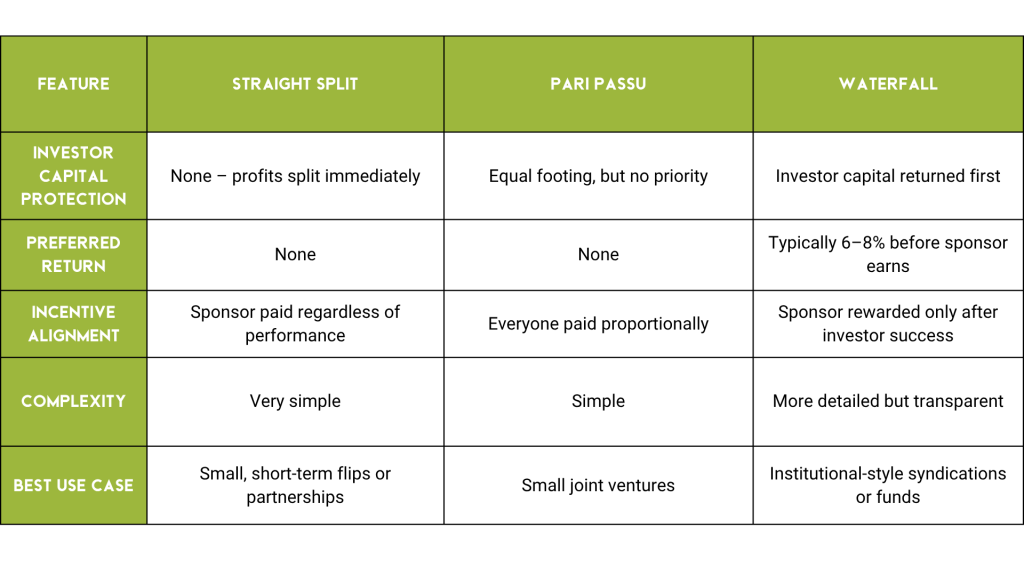
Now Let’s Compare Them Side-by-Side
You can see why professional investors tend to prefer the waterfall.
It’s the only model that balances protection, motivation, and transparency in a single framework.
Why This Comparison Matters
Two identical properties could yield completely different investor outcomes depending on the structure.
For example:
Under a straight split, if a project earns 8% annually, you and the sponsor divide it 70/30—even if you took all the capital risk.
Under a waterfall, you’d receive your full 8% preferred return before the sponsor participates. Only when returns exceed that hurdle does the sponsor’s share increase.
Same property, same income—very different result.
That’s why experienced investors look beyond the pro forma and ask:
“How is the deal structured?”
Because how you earn often matters more than how much you earn on paper.
Final Thought
A syndication’s structure is like its moral compass; it determines whether the relationship between investor and operator is built on balance or bias.
The Straight Split is simple but exposes investors.
Pari Passu feels equal but ignores effort.
The Waterfall requires more explanation but delivers fairness through order.
Understanding these differences doesn’t just make you a better investor; it keeps you from being the one left with crumbs while everyone else eats cake.
Small Rental Properties vs. Large Real Estate Investments: The Math That Changed My Mind
Many investors assume more properties mean more wealth. But when...
Read MoreThe Productivity Problem Nobody Wants to Talk About
Productivity growth has slowed, employee engagement is declining, and inefficiencies...
Read MoreThe Employees Every Business Owner Dreams of Finding
Some employees do more than complete tasks—they take ownership, solve...
Read MoreHow Delivery Apps Are Squeezing Local Restaurant Profit Margins

Food delivery apps promised restaurants more customers and more sales....
Read MoreThe 30% Fee That’s Quietly Killing Your Favorite Local Restaurants

Most people don't realize how much of their delivery order...
Read MoreThe Real Reason Some Businesses Survive While Others Disappear

The companies that last aren't necessarily the smartest or the...
Read MoreThe Reality of Small Business Ownership That Most People Never See

Every thriving small business exists because someone was willing to...
Read MoreHow Real Estate Development Creates Jobs, Growth, and Stronger Communities

A new building is more than concrete and steel. It...
Read More